Showing posts with label Poetry. Show all posts

Tuesday, December 17, 2013

Poetry in Motion

I write poetry. I know you find that hard to believe....not! But I have written it for years. I began writing it when I was eight; the year my brother died.  I needed some kind of outlet and poetry gave me just that.  It was a place I could release all the feelings, fears, anger, hurt and pain.  Music became my other outlet. I need music just like I need air to breathe. It is life blood for me. My grandfather was the starting source of my music. He took time with all of us when we were young and taught us all to play guitar if we wanted to learn. I was one of his students. When he died my grandmother gave me his mandolin.  It was a humped back one called a "tater bug" and it had suffered a lot of use and misuse.  There are missing inlays and it has a crack or two in the back....but I love it.  Several years later I penned this poem.


The Mandolin

Round back bent and broken

from years of nightly use

inlays missing, dusty,

rusty from neglect and abuse.

Strings that are still and silent,

out of tune, played no more.

Once a master stroked you,

coerced the sound to soar.

The songs that lie encased,

inside your wooden heart.

These songs were my beginning,

where I got my musical start.

My grandfather once held you,

just like he once held me.

And when he touched our heart strings,

set both out spirits free.

When I hold you now I know,

that I am gree to know,

where eagles fly, where steel wheels turn,

where'er I want to go.

Thank you Grandpa for this gift,

your favorite mandolin.

I'll use it - while I'm here -

and then pass it on again!

This poem and mandolin sparked another flame of musical symbolism in my soul and I began thinking about myself. The writer, the musician, the singer...and found myself asking...

Body Music

Who are you?

Where is the face I looked at yesterday....or was that last year?

God! This is so depressing.

I still feel young....yet, I am seeing my mother

in this mirror more and more.

My hands are short and stocky,

remnants of my Creek Indian Heritage.

These hands were made to work hard and the

calloused fingers are testimonials

that they have.

My eyes see into your soul.

I want to know you and I usually do...

many times on a plane higher than you are

even aware of.

My eyes are the windows to my very being.

They tell you when I 'm sick, tired, distressed,

or even....lying!

My eyes have never learned to keep secrets.

My mouth is not too big, so I don't

shoot it off without provocation.

It is not so small either.

I will strike up a conversation with anyone.

I like people.

Strangers are just people I haven't met yet.

My ears are large enough to listen when

my friends need a friend, yet

small enough to easily shut out

thinks I don't want to hear

at the most convenient times.

My body, once looked like a sleek, classical guitar

before the days of children and marriage.

Now I see a bass violin - curved, but

definitely thicker.

All in all I like me.

We can't all be classical guitars.

The worlds orchestration needs a mixture

of musical types.

I am a bass fiddle, at this time in my life...

so close your eyes and hear my music.

As I leave you with my poetic offerings today I give you this mock Irish blessing.  May your music today be soothing. May you share your song with all those you come in contact with...and no matter what instrument you play....may you know that you are part of a great earthly band called the human race.  God Bless you and yours today.

Monday, February 25, 2013

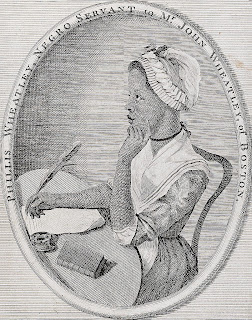
Biography - Boston Slave Poet Phillis Wheatley d. 12/5/1784

.

I think that the first time I learned much about Phillis Wheatley was in an American Literature class at the University of North Carolina in the mid 1960s. Her story and her poems were fairly amazing. I understood why those educated, self-absorbed "gentlemen" in the 18th century doubted that a young slave girl could produce those classical poems, or that any woman could write like that.

American poet Phillis Wheatley probably was born in Senegal, Africa in the early 1750s. Her only written memory of Africa was of her mother performing a ritual of pouring water before the sun as it rose. When she was about 7, she became a commodity. She was kidnapped from her family, marched to the coast, sold to Peter Gwinn as slave cargo, and stowed on a ship called The Phillis for an unimaginable trip through the middle passage. When the dark ship finally reached its destination in Boston, the frightened little girl was sold at John Avery's slave auction to tailor John and his wife Susanna Wheatley on July 11, 1761. The prosperous Boston family named their new acquisition after the ship she arrived in; taught her English, Latin, and Greek; and treated her as a family member. The Wheatleys and their daughter, Mary, introduced Phillis to the Bible; and to 3 English poets – Milton, Pope and Gray. Phillis used her new language skills to write her own poetry.

She published her first poem at the age of 14. Her poem "On Messrs. Hussey and Coffin" appeared in the Newport Mercury in 1767. She was especially fond of writing in Pope's elegiac poetry style, perhaps because it also mirrored an oral tradition of her African tribal group. Both Europeans and Africans used poem and song as a lament for a deceased person. That she also was well-versed in Latin, which allowed her to write in the epyllion (short epic) style, became apparent with the publication of "Niobe in Distress."

She became a sensation in Boston in the early 1770s, when her poem elegy on the death of the extremely popular English-born evangelist George Whitefield gained wide circulation in colonial newspapers. Whitefield died September 30, 1770, in Newburyport, Massachusetts. Wheatley's elegy reached Selina Hastings of England, Countess of Huntingdon, who was a great admirer of Whitefield. The countess, in turn, sent Wheatley's poem to London papers, which reprinted it many times.

Because many found it hard to believe that a slave or a woman could write such poetry, in 1772, Wheatley received an attestation of authenticity from a group of Boston luminaries including John Hancock and Thomas Hutchinson, the governor of Massachusetts, which was printed in the preface to her book Poems on Various Subjects, Religious and Moral released in London in 1773. The book was issued from London, because publishers in Boston refused to publish it. Wheatley and her master's son, Nathanial Wheatley, had traveled to London, where the Countess of Huntingdon and the Earl of Dartmouth helped finance the publication.

Phillis' fame and the aging of her owners ultimately brought her freedom from slavery on October 18, 1773, just as the British American colonies were contemplating a freedom of their own. She received a letter from General Washington, after she had written a poem to Washington, lauding his appointment as commander of the Continental Army. On February 28, 1776, Washington wrote to Wheatley, "I thank you most sincerely for your polite notice of me, in the elegant Lines you enclosed; and however undeserving I may be...the style and manner exhibit a striking proof of your great poetical Talents."

Though Benjamin Franklin received her, and Washington personally met with her as well, Thomas Jefferson refused to acknowledge her intelligence and skill. In Notes on the State of Virginia, he declared, "Religion, indeed, has produced a Phillis Wheatley, but it could not produce a poet. The compositions published under her name are below the dignity of criticism."

Adopting classical styles, topics, neoclassical images, and scriptural allusions, allowed Wheatley to express a subtle critique of America's slaveholding colonies and emerging new republic. While she was a strong supporter of independence during the Revolutionary War, she felt slavery was the issue which kept Ameican whites, such as Jefferson, from true heroism. Wheatley wrote that whites could not "hope to find/Divine acceptance with th' Almighty mind" when "they disgrace/And hold in bondage Afric's blameless race."

In a letter which appeared on March 11, 1774, in the Connecticut Gazette, Wheatley wrote of the hipocrisy of freedom-loving slaveholders, "God grant Deliberance...upon all those whose Avarice impels them to countenance and help forward the Calamities of their fellow Creatures. This I desire not for their Hurt, but to convince them of the strange Absurdity of their Conduct whose Words and Actions are so diametrically opposite, How well the Cry for Liberty, and the reverse Disposition for the exercise of oppressive power over others agree I humbly think it does not require the penetration of a Philosopher to determine."

On April 1, 1778, she married a free black Bostonian named John Peters. Initially this marriage produced 2 babies who died in childhood. Despite tragedy and poverty, Phillis continued to write poetry. In 1779, she advertised in the Boston Evening Post and General Advertiser, in hopes of finding a publisher for a volume of 33 poems and 13 letters. In the struggling post-revolutionary economy, this volume was never published. In September 1784, The Boston Magazine published under her married name, Phillis Peters, a poem "To Mr. and Mrs.----, on the Death of Their Infant Son;" and in December, 1784, it published "Liberty and Peace" celebrating the outcome of the Revolutionary War, once again using her married name. She may never have seen the poems published in December.

By this time, her husband had deserted her, forcing Wheatley to earn a living as a scullery maid in a Boston boarding house for destitute blacks. On December 5, 1784, she died there in poverty at the age of 31, probably from an infection or blood clot contracted while giving birth. Her third baby died only a few hours later. They were buried together in an unmarked grave. The Boston Independent Chronicle reported, "Last Lord's Day, died Mrs. Phillis Peters (formerly Phillis Wheatley), aged thirty-one, known to the world by her celebrated miscellaneous poems. Her funeral is to be this afternoon, at four o'clock, from the house lately improved by Mr. Todd...where her friends and acquaintances are desired to attend."

Before her death, she had addressed several other poems to George Washington. She sent them to him, but he never responded again. Her last known poem was written for Washington. After Phillis' death, her estranged husband, John Peters, went to the woman who had provided temporary shelter for Phillis and demanded that she hand over the manuscripts of the proposed second volume. After Peters received Phillis' manuscripts, the second volume was never seen again.
.

Tuesday, February 28, 2012

Trains Go by Steve Light - ADVISABLE

Light, Steve. Trains Go Chronicle Books, 2012. $8.99. Content G- BOARD/PICTURE BOOK. The shape of the book adds to the fun of it. It’s about 12”x6” so opened it’s 24” long! Each page shows a different type of train along with the sound it makes. This a great book for train lovers, and teachers that want to expose their students to onomatopoeia for the first time. PRE-K, EL - ADVISABLE. Shauna, reading teacher.

Tuesday, January 17, 2012

Zorgamazoo by Robert Paul Weston - ESSENTIAL


Weston, Robert Paul Zorgamazoo, 288 pgs. Penguin Group (USA) Incorporated, 2008. Language – G (0 swears); Mature Content – G; Violence – G;

If you’re searching to find a cleverly book,
then Zorgamzoo deserves a really good look.
It has ogres and pixies and fantastical creatures,
With horns on their heads and other such features.
Katrina Katrell, an imaginative girl,
has fled from Mrs. Krabone in a really big whirl.
She meets up with Mortimer, a zorgel for sure,
His last name is Yorgel out on an adventure quite pure.
He is hunting lost Zorgels who were gone in the night,
With Winnie the beast who is a terrible sight.
The Zorgels have been captured, yes stolen from home.
And Winnie was left by herself, all alone.
The heroes were taken to a place on the moon,
Their freedom, their escape can come none too soon.
The story is good with a moral not bad,
The ending is fun and not even sad.
There are pictures that help the story seem real,
And give an impression of truth with a zeal.
The book it is written in verses that rhyme,
And read it out loud for a very good time.

HS – ESSENTIAL. Reviewer: W. Child - Cyprus High Library Media Specialist

Tuesday, January 10, 2012

Mosquitoes Are Ruining My Summer by Alan Katz - ADVISABLE


Katz, Alan Mosquitoes Are Ruining My Summer, 27 pgs.  Margaret K. McElderly Books, 2011.  $16.99. Language-G (0 swears, 0 “f”), Sexual Content-G; Violence-G; This book is a fun, sing-songy book that is perfect for kids.  The illustrations are fabulous and familiar by David Catrow.  Children everywhere will enjoy singing different words to the familiar tunes.  It is funny.  I read it to my fifth graders and they laughed and laughed, especially about one of the poems about a guy who doesn’t do his laundry.  This is a marvelous book.  EL - ADVISABLE.  Reviewer:  BMN

Friday, December 9, 2011

Poems I Wrote When No One Was Looking by Alan Katz - ESSENTIAL


Katz, Alan Poems I Wrote When No One Was Looking, 145 pgs. Margaret K. McElderry, 2011. $18.00. Language: G (0 swears, 0 “f”); Mature Content G; Violence G; This is a laugh-out-loud book full of fun poems for people of any age. The poems are written about simple everyday occurrences like: avoiding homework, listening to your sister practice the violin, driving in the car with Mom and Dad, and hoping for snow days so you don’t have to go to school. The book plays with words, sounds, and meanings which is what we want kids to do as they develop language skills. The book could also be used in the upper grades to get students excited about poetry. The poems are short and easy to read. It’s a delightful book. EL, MS, HS (appropriate for everyone) – ESSENTIAL. Reviewer: M. Mathews teacher librarian

Tuesday, February 1, 2011

Copley's Concern About Being "A True Artist"

.
I have been fretting about John Singleton Copley's worry that as a painter living in the Anglo American colonies, he was just an artisan painting portraits. He longed to become a true artist whose paintings elevated society. His artist stepfather Peter Pelham, a professional purvayor of culture and art who immigrated to Boston from England in the 1720s, would have been well aware of the discussion of the lofty status of an artist in England.

Recently, while reading the earliest copies of the Maryland Gazette on the Maryland State Archives website, I came upon this article, and I understood Copley's tension and disappointment more clearly. The composition is surely a reflection on Horace's Ars poetica, "Ut pictura poesis" -- "as is painting, so is poetry."
This essay first appeared in England called The Free Thinker in 1718. It appeared in Maryland in ten years later in 1728, in the 3rd issue of the first Maryland newspaper ever printed.

The Maryland Gazette From Tuesday, December 17, to Tuesday, December 24, 1728.

Ut Pitura Poesses erit. --
Sir,
The Verses, in the Close of this Paper, furnish me with a proper Occasion to make a few Reflections, upon Poetry and Painting, which may not be unacceptable to such as delight in Either, or Both, of These Arts.
The surprizing Excellency, which is peculiar to a Great Poet, is the Skill of conveying to Another, by the Help of Words, those just and lively Ideas, which rise in his Imagination, in the same Force and Perspicuity, as He himself conceives them. Words, in His Disposal, are Things : And, the Deception proves so strong, that the Reader forgets he is perusing a Piece of Writing or, at least, takes the Poem for a Book of Magick, which (as he passes from one Period to another) surrounds him with amazing Objects and drives him from Passion to Passion ; transporting him into Joys and Griefs, Pleasures and Pains, with a Violence not to be refilled.
The Perfection of a Master-Painter is, to be able to perform the same Wonders by Colours, which the Poet commands by Language. His Ideas pass from his Mind into his Pencil, and rise upon the Canvas in their full Vigour and Proportion. His every Touch is a Creation : The Canvas is no longer a level, lifeless Surface ; but a Scene, diversify with Buildings, Mountains, Forrests; or, perhaps, a Sea, deformed with Tcmpels ; a Sky, enraged with Storms, flashing out Lightning; and Clouds, bursting with Thunder : Or, a Field of War, stained with Blood, and filled with Uproar and Confusion : Or, perhaps, the silent, solitary Retreat of Sorrow and Despair ; or, if he pleases, the Enchanted Bower of Bliss, the Residence of Love and Beauty.
Such is the Efficacy of Words and Numbers; and such the Energy of Lights and Shades, under the Conduct of a superiour Genius : Both equally wonderful in their Operations; both equally Pleasing: But not alike Infinitive; in which Point, the Poet unquestionably claims Preminence over the Painter.
It would be hard to determine which of these Two Arts require the greater Power of Imagination, the longer Term of Experience and the more unwearied Application. It seems equally difficult to paint in Words, or in Colours; so as to impose the One upon the Reader, and the Other on the Beholder, for Realities. The Great Poet, and the Great Painter, think alike : But, They express their Thoughts by very difierent Powers. The Painter's Language is his Colours : The Poet's Colours are his Diction. The strongest Colouring will fade ; and the most significant Words grow obsolete. Many of the most celebrated Writings of Antiquity are preserved : The Paintings are all perished. The Painter is equally understood in all Nations: And the Poet can distribute every One of his Performances into the Hands of all his Countreymen.

The Poet and the Painter may mutually improve one another, by judiciously perusing each others Works. The Similitudes, the Descriptions, and Metaphors of the One ; the Landskips, Figures, and Postures, of the Other, equally tend to regulate, and enliven, the Imagination. The violent Motions of Nature are so very Transient, that it is diffcult to catch distinct Ideas of them from the Life: Whereas, when a Great Painter has fixed a Passion in a Face, the Poet may there study the Workings of it in the Features, at his Leisure: And the Painter may, in his Turn, receive the like Advantage from the Poet.

It is true, the greatest Skill in these Artists, when they arrive to the Perfection of copying happily One from the Other. There is not the least Resemblance between Words and Colours, as there is between different Languages : And therefore, it requires a strong Faculty of Imaging, and a just Manner of Thinking, to be able to Translate out of One of These into the Other, without loosing the Spirit.
To read the Maryland Gazette online go to

http://aomol.net/html/mdgazette.html
Throughout the 18th century, the Maryland Gazette was published in Annapolis, Maryland. Annapolis, Anne Arundel County: Printed by W. Parks, 1727-1734; Printed by Jonas Green and William Rind, 1758-1765; Printed by Jonas Green, 1765-1767; Printed by Anne C. Green, 1767; Printed by Anne C. and William Green, 1768-1770; Printed by Anne C. Green, 1770-1771; Printed by Anne C. Green and Son, 1772-1775; Printed by Frederick Green, 1776-1777; Printed by Frederick and Samuel Green, 1779-1811. .