c 1749 John Wollaston (American colonial era painter, 1710-1775) Lucy Parry, Wife of Admiral Parry
English rococo portraitist John Wollaston arrived in New York from England in 1749, where he worked for 2 years. It seems that Wollaston came across the Atlantic specifically to paint portraits and then to return to England. A contemporary label on his 1751 portrait of colonial William Smith, Jr. refers to "Johnannes Wollaston Londoniensis." Little is know about his training in England. Charles Willson Peale wrote to his son Rembrandt in 1812, that Wollaston trained in London with a painter of drapery. Wollaston left England just as Neoclassicism, as a reaction against baroque and rococo styles, was spreading throughout England and Europe.
1745-1748 John Wollaston (American colonial era painter, 1710-1775) Portrait of a Lady
He traveled south from New York to paint briefly in Philadelphia in 1752; and, by the winter of 1753, Wollaston moved south to Annapolis, Maryland, and then on to Virginia by 1755. In Annapolis, he painted at least 60 portraits of Marylanders.
1749-52 John Wollaston (American colonial era painter, 1710-1775) Portrait of a Woman
Wollaston's rococo portraits were a hit in Maryland's capital of Annapolis. The March 15, 1753,
Maryland Gazette carried the following poem honoring Wollaston.
"On Seeing Mr. Wollaston’s Pictures, in Annapolis," by a Dr. T. T.
Behold the wond’rous Power of Art!
That mocks devouring Time and Death,
Can Nature’s ev’ry Charm impart;
And make the lifeless Canvas breathe.
1749 John Wollaston (American colonial era painter, 1710-1775) Margaret Tudor (Mrs. Richard Nicholls)
In the Chesapeake, he painted the families of many plantation-owning gentry. He returned to the city-life of Philadelphia in 1758, seeking more commissions. Some suggest that he may have sailed for the West Indies from Philadelphia. In the fall of 1765, he reappeared in the bustling, high-style port city of Charleston, South Carolina, where he painted at least 17 portraits. Although there is no written record of his associations, Wollaston may have known younger artsts Robert Feke, John Hesselius, and perhaps Benjamine West. He may have known Jeremiah Theus, while he was painting in Charleston.
1749-52 John Wollaston (American colonial era painter, 1710-1775) Catherine Harris Smith (Mrs. Ebenezer Pemberton)
On January 19, 1767, Wollaston, announced his plans to leave Charleston to return to England, in the
South Carolina Gazette:
"The Subscriber intending for England in a few weeks, takes this public method of returning thanks, to all gentlemen and ladies who have been so good to employ him: Those who may have any demands upon him, are desired to bring in their accounts; and of those who are indebted to him he requests the favour they will discharge the same."
1749-1752 John Wollaston (American colonial era painter, 1710-1775) Mrs Joseph Reade
1749-1752 John Wollaston (American colonial era painter, 1710-1775) Mary Walton Morris
1750 John Wollaston (American colonial era painter, 1710-1775) Experience Johnson Mrs Samuel Gouverneur
1750 John Wollaston (American colonial era painter, 1710-1775) Rachel Levy (Mrs Isaac Mendes Seixas) 1719-1797
1750s John Wollaston (American colonial era painter, 1710-1775) Ann Langdon (Mrs Richard Ayscough)
1750s John Wollaston (American colonial era painter, 1710-1775) Anne Carter Harrison Randolph (c. 1724-after 1793)
1750s John Wollaston (American colonial era painter, 1710-1775) Mary Bryant (Mrs William Peartree)
1750s John Wollaston (American colonial era painter, 1710-1775) Mary Meade Walker
1750s John Wollaston (American Colonial Era artist, 1733-1767) Mrs James Alexander c 1749-60
1751 John Wollaston (American colonial era painter, 1710-1775) Mrs Margaret Chew Bradley
1752 John Wollaston (American colonial era painter, 1710-1775) Dorothy Willing (Mrs. Walter Stirling)
1752 John Wollaston (American colonial era painter, 1710-1775) Mrs Philip Livingston
1752 John Wollaston (American colonial era painter, 1710-1775) Mrs Pontius Stelle
1753-54 John Wollaston (American colonial era painter, 1710-1775) Mrs Daniel Carroll II (1710-1775) & Daniel Carroll (1752-1790)
1754 John Wollaston (American colonial era painter, 1710-1775) Elizabeth Tasker (Mrs Christopher Lowndes)
1754 John Wollaston (American colonial era painter, 1710-1775) Mrs Charles Carroll
1755 John Wollaston (American colonial era painter, 1710-1775) Elizabeth Harrison (Mrs Peyton Randolph)
1756 John Wollaston (American colonial era painter, 1710-1775) Mrs William Allen
1757 John Wollaston (American colonial era painter, 1710-1775) Martha Dandridge (Daniel Parke Custis) (Mrs George Washington)
1758 John Wollaston (American colonial era painter, 1710-1775) Mary Willing (Mrs William Byrd III)
1760 John Wollaston (American colonial era painter, 1710-1775) Mary Carroll Mrs Charles Carroll of Duddington
1765 John Wollaston (American colonial era painter, 1710-1775) Mary Ross Beale.
1765-67 John Wollaston (American colonial era painter, 1710-1775) Lady in Gold Dress from Charleston, South Carolina
1765-67 John Wollaston (American colonial era painter, 1710-1775) Mary Ross Mrs John Beale
John Wollaston (American colonial era painter, 1710-1775) Frances Tasker (Mrs Robert Carter)
John Wollaston (American colonial era painter, 1710-1775) Portrait of a Lady
1767 John Wollaston (American colonial era painter, 1710-1775) Ann Gibbes Mrs Edward Thomas


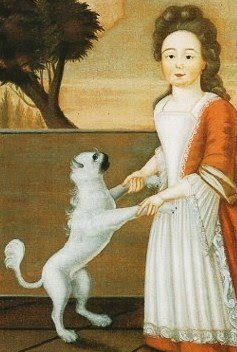 1710s Justus Engelhardt Kuhn (fl 1707-1717) Young Girl
 1715 Attributed to Charles Bridges (1670-1747). Child of Rev. Richard Chase (1692-1742) of London and Maryland, and his wife Margaret Frances Townley (d. 1741)
 1730s Child of the Pierpont Family.
 c. 1735 Charles Bridges (1670-1747). Anne Byrd.
 1720s-30s Gerardus Duyckinck (1695-1746). Jacomina Winkler
 1755 John Singleton Copley (1738-1815). The Gore Children.
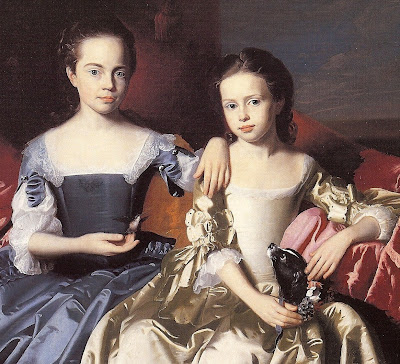 1758 John Singleton Copley (1738-1815). Mary MacIntosh Royall and Elizabeth Royall.
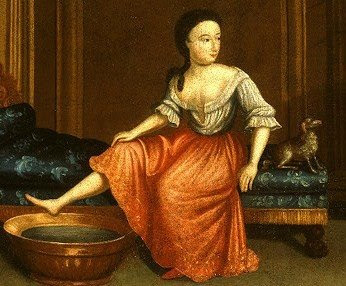 1730s Gerardus Duyckinck (1695-1746). Lady Undressing for a Bath.
 1730 John Simbert (1688-1751). Mrs Nathaniel Cunningham.
+Magdalen+Charlton+(Mrs.+Thomas+Dongan).+Museum+of+Fine+Arts,+Boston.jpg) C 1750 John Wollaston (1710-1775) Magdalen Charlton (Mrs. Thomas Dongan).
C 1750 John Wollaston (1710-1775) Magdalen Charlton (Mrs. Thomas Dongan)..+Anne+Allen+(Mrs.+John+Penn)..jpg) c 1760 Benjamin West (1738-1820). Anne Allen (later Mrs. John Penn). John Penn (1729-1795) was the last governor of colonial Pennsylvania, serving from 1763-1771 & 1773-1776, & he was a grandson of William Penn. Portrait of the daughter of West's benefactor Chief Justice William Allen may have been painted as West was traveling from Pennsylvania to Italy and then to England.
c 1760 Benjamin West (1738-1820). Anne Allen (later Mrs. John Penn). John Penn (1729-1795) was the last governor of colonial Pennsylvania, serving from 1763-1771 & 1773-1776, & he was a grandson of William Penn. Portrait of the daughter of West's benefactor Chief Justice William Allen may have been painted as West was traveling from Pennsylvania to Italy and then to England. 1760 English artist James McArdell (1728-1965) after Joshua Reynolds Joshua Reynolds (English Rococo Era Painter, 1723-1792).
 1763 John Singleton Copley (1738-1815) Mrs Jerathmael Bowers.
 1773 Gilbert Stuart (1755-1828). Christian Stelle Banister & Son John
 1787 Henry Benbridge (1743-1812). Hartley Family.
+Elizabeth+Davis+Mrs+Hezekiah+Beardsley+1749-1790+Yale+Univ+Art+Gallery1st-gallery-art.com.jpg) 1785-90 Beardsley Limner Possibly Sarah Bushnell Perkins (1771 - 1831). Elizabeth Davis (Mrs Hezekiah Beardsley).
1785-90 Beardsley Limner Possibly Sarah Bushnell Perkins (1771 - 1831). Elizabeth Davis (Mrs Hezekiah Beardsley). 1789 - 1791 Payne Limner. Martha Payne.