Abigail Smith was born on November 11, 1744, in Weymouth, Massachusetts, the 2nd child of Elizabeth Quincy Smith & the Reverend William Smith. Her father was pastor of Weymouth's North Parish Congregational Church. Abigail's mother, Elizabeth, spent much of her time visiting the sick & distributing food, clothing, & firewood to needy families. Young Abigail accompanied her mother on these visits putting into practice the lessons her father taught at church. Abigail educated herself in her father's library.
Abigail Adams (1744-1818) by Gilbert Stuart (American artist, 1755-1828)
When she was 18, Abigail met John Adams, a young lawyer from nearby Braintree. During their 2 year courtship, the young couple spent long periods apart & relied upon writing letters to keep in touch. On October 25, 1764, Abigail's father presided over their wedding. The young couple moved into the small house John had inherited from his father in Braintree to begin their life together. Abigail proved to be exceptionally capable of managing the family's finances & household. Meanwhile, John's began to ride the court circuit (traveling from one district to another) building a successful law career. On July 14, 1765, John & Abigail's 1st child, Abigail, was born."Nabby," as she was called, was followed by son John Quincy Adams on July 11, 1767, Susanna (who died just after her 1st year), Charles, & Thomas Boylston. The young couple continued to live on John's small farm at Braintree or in Boston as his practice expanded. In ten years she bore three sons & two daughters; she looked after family & home; when he went traveling as circuit judge.
"Alas!" she wrote in December 1773,
"How many snow banks divide thee and me...."John Adams decided to move his family to Boston, because his work was located there. The Adamses friends inlcuded John's cousin Samuel Adams, John Hancock, James Otis, & Joseph Warren. Long separations kept Abigail from her husband while he served the country they loved, as delegate to the Continental Congress, envoy abroad, elected officer under the Constitution. Her letters--pungent, witty, & vivid, spelled just as she spoke--detail her life in times of revolution. They tell the story of the woman who stayed at home to struggle with wartime shortages & inflation; to run the farm with a minimum of help; to teach 4 children when formal education was interrupted. Most of all, they tell of her loneliness without her
"dearest Friend." The Boston Massacre occured on March 5, 1770. At the risk of his own popularity & career, John Adams chose to defend 8 British soldiers & their captain, accused of murdering 5 Americans. Although John was an ardent patriot & favored independence, he felt the soldiers had acted properly & been provoked into firing by an unruly mob. Also, he felt it was important to prove to the world that the colonists were not under mob rule, lacking direction & principles, & that all men were entitled to due process of law. Most Americans, driven by emotion, were angry with Adams for defending the hated "redcoats," but throughout the ordeal Abigail supported her husband's decision. In the end, Adams was proved correct & all 9 of the men were acquitted of the murder charges. While the verdict diffused this crisis, far greater ones were destined for the colonies.

1798 Watercolor of the Old House of John & Abigail Adams by E. Malcom The Old House, built in 1731, became the residence of the Adams family for 4 generations from 1788 to 1927.
In 1774 John traveled to Philadelphia, Pennsylvania, as a delegate to the First Continental Congress; where America made its first legislative moves toward forming a government independent of Great Britain. Abigail remained in Braintree to manage the farm & educate their children. Again, letter writing was the only way the Adamses could communicate with each other. Their correspondence took on even greater meaning, for Abigail reported to her husband about the British & American military confrontations around Boston. Abigail took her son John Quincy to the top of Penn's Hill near their farm to witness the Battle of Bunker Hill on June 17, 1775.
Not all Americans shared the Adamses' vision of an independent nation. To those that wavered, Abigail argued, "A people may let a king fall, yet still remain a people: but if a king lets his people slip from him, he is no longer a king. And this is most certainly our case, why not proclaim to the world in decisive terms, your own independence?" John agreed with his wife; & in June 1776, was appointed to a committee of five men to prepare a Declaration of Independence from Great Britain.
1820 Sketch of the Mansion by Abigail Adams Smith who lived with her grandfather John Adams in the Old House from 1818-1829
Abigail's vision of independence was broader than that of the delegates. She believed all people, & both sexes, should be granted equal rights. In a letter to John she wrote, "I wish most sincerely that there was not a slave in the province. It always seemed to me to fight ourselves for what we are robbing the Negroes of, who have as good a right to freedom as we have." Later Abigail added that John & his fellow delegates should "remember the ladies, & be more generous & favorable to them than you ancestors" when they enact new codes of law. Her views were far too progressive for the delegates of the Continental Congress.
John soon was appointed president of the Board of War & turned to Abigail for advice on carrying out his job. Throughout his career, Adams had few confidants. Thus Abigail advised her husband, & John valued her judgment so much that he wrote his wife,
"I want to hear you think or see your thoughts."1828 A drawing of The Adams Seat in Quincy by Mrs. George Whitney
In 1778, John Adams was sent to Paris on a special mission to negotiate an alliance with France. He remained in Europe from 1778 to 1787, through a succession of different appointments, except for a 3 month rest at home; during which time he drafted the Massachusetts Constitution. Separated from her husband by the Atlantic Ocean, Abigail continued to keep their farm running, paid their bills, & served as teacher to their children. She particularity labored to develop the great abilities of her son John Quincy, who had joined his father in Europe. In one letter to her son, she inspired him to use his superior abilities to confront the challenges before him:
"These are times in which a genius would wish to live. . . . Great necessities call out great virtues."John Adams by William Joseph Williams, C. 1797.
In 1784, with independence & peace secured from Great Britain, Abigail sailed to Europe to join her husband & son. Abigail spent 4 years in France & England, while her husband served as U.S. minister to Great Britain. As the wife of a diplomat, she met & entertained many people in Paris & London. While never at home in these unfamiliar settings, Abigail did her best to enjoy the people & places of both countries. Abigail was pleased, when the time came to return home to Braintree in 1788.
1846 Woodcut of the Residence of John Quincy Adams
The next year, John Adams was elected the 1st vice president of the United States. During the course of the next 12 years as John Adams served 2 terms as vice president (1789-1797) & 1 term as president (1797-1801), he & Abigail moved back & forth between Braintree (
the "Old House") & the successive political capitals of the United States: New York, Philadelphia, & then, briefly, at the unfinished White House in Washington, D.C.
Portrait of John Adams by William Winstanley, 1798.
Abigail had recurring bouts of rheumatism that forced her frequently to retreat to the peace of Braintree recover. After 1791, poor health forced her to spend as much time as possible in Quincy. Illness or trouble found her resolute; as she once declared, she would
"not forget the blessings which sweeten life." In 1796, John Adams was elected to succeed George Washington as president of the United States. Party lines were forming. John Adams faced dissent in his cabinet & the vice president, Thomas Jefferson, was head of the opposition party. John realized the problems he faced & wrote to his wife, who was in Quincy recovering from a rheumatic bout, that
"I never wanted your advice & assistance more in my life." Abigail rushed to her husband's side & maintained a grueling schedule to perform all her duties as first lady. She entertained guests & visited people in support of her husband. The first lady had a limited budget to carry out her duties, but she compensated for this with her attentiveness & charm.
1849 Daguerreotype of the Old House of John & Abigail Adams by John Adams Whipple
Meanwhile, Great Britain was at war with France, & popular opinion held that America should jump in to aid Great Britain, especially after France insulted the United States by demanding bribes. The president felt that war would weaken the United States & decided on the unpopular course of neutrality. During this time many of Adams' opponents used the press to criticize his policies. Abigail was often referred to as
"Mrs. President," for it was widely believed that the president's decisions were heavily influenced by his wife. In reality Abigail disagreed with her husband's stand of neutrality; but people believed she was setting his policies, & this weakened John Adams politically.
1849 Painting of the Old House of John & Abigail Adams by G. Frankenstein
In 1798, with John Adams' approval, Congress passed the Alien & Sedition Acts, which were aimed at restricting foreign influence over the United States & weakening the opposition press. Abigail supported these measures, because she felt they were necessary to stop the press from undermining her husband. The acts proved very unpopular, with Thomas Jefferson & James Madison leading the protest against them. Adams' support of these acts undermined his popular support, already suffering from his courageous but unpopular stand on war with France, & led to his failure to be reelected in 1800.
1852 View of the Adams Mansion at Quincy by Mallory, C. 1852 from “Gleasons’ Pictorial Drawing Room Companion” Volume 3, August 21, 1852.
In March 1801, John & Abigail retired to Quincy. During her last years, Abigail occupied herself with improving her home & entertaining visiting children, grandchildren, nieces, & nephews. The proud mother watched as her son John Qunicy Adams distinguished himself as a U.S. senator, minister to Russia, & secretary of state. In October 1818, Abigail contracted typhoid fever. Surrounded by family members, she died on October 28. John Adams & his wife had shared 54 years of happiness & companionship, & John wrote,
"I wish I could lay down beside her & die too."Portrait of John Adams at age 88 by Jane Stuart, after Gilbert Stuart, 1824.
See
National Park Service Adams House
 Cosmo Alexander (1724-1772) Self Portrait c 1747
 1745-50s Cosmo Alexander (1724-1772.) Portrait of a Jacobite Lady.
 1770 Cosmo Alexander (1724-1772). Margaret Stiles Manning.
 1770 Cosmo Alexander (1724-1772). Mary Jemima Balfour.
 1770 Attributed to Cosmo Alexander (1724-1772). Girl with a Lamb.
 1770 Attributed to Cosmo Alexander (1724-1772). Girl with a Squirrel.
 Gilbert Stuart (1755-1828). Self Portrait


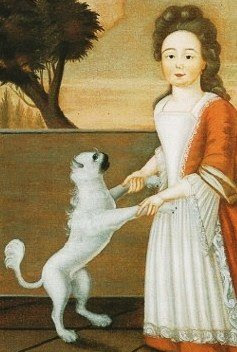 1710s Justus Engelhardt Kuhn (fl 1707-1717) Young Girl
 1715 Attributed to Charles Bridges (1670-1747). Child of Rev. Richard Chase (1692-1742) of London and Maryland, and his wife Margaret Frances Townley (d. 1741)

 1730s Child of the Pierpont Family.
 c. 1735 Charles Bridges (1670-1747). Anne Byrd.
 1720s-30s Gerardus Duyckinck (1695-1746). Jacomina Winkler
 1755 John Singleton Copley (1738-1815). The Gore Children.
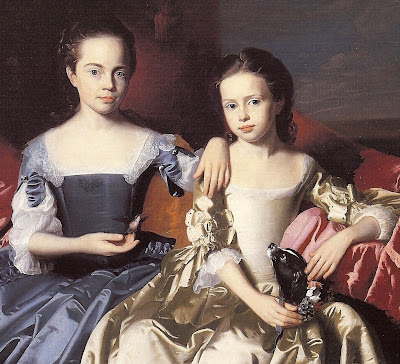 1758 John Singleton Copley (1738-1815). Mary MacIntosh Royall and Elizabeth Royall.
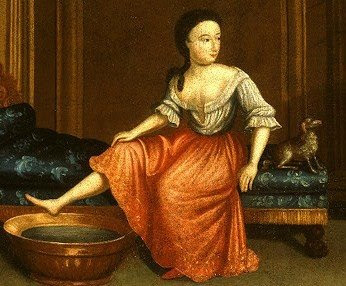 1730s Gerardus Duyckinck (1695-1746). Lady Undressing for a Bath.
 1730 John Simbert (1688-1751). Mrs Nathaniel Cunningham.
 C 1750 John Wollaston (1710-1775) Magdalen Charlton (Mrs. Thomas Dongan).
 c 1760 Benjamin West (1738-1820). Anne Allen (later Mrs. John Penn). John Penn (1729-1795) was the last governor of colonial Pennsylvania, serving from 1763-1771 & 1773-1776, & he was a grandson of William Penn. Portrait of the daughter of West's benefactor Chief Justice William Allen may have been painted as West was traveling from Pennsylvania to Italy and then to England.
 1760 English artist James McArdell (1728-1965) after Joshua Reynolds Joshua Reynolds (English Rococo Era Painter, 1723-1792).
 1763 John Singleton Copley (1738-1815) Mrs Jerathmael Bowers.
 1773 Gilbert Stuart (1755-1828). Christian Stelle Banister & Son John
 1787 Henry Benbridge (1743-1812). Hartley Family.
 1785-90 Beardsley Limner Possibly Sarah Bushnell Perkins (1771 - 1831). Elizabeth Davis (Mrs Hezekiah Beardsley).
 1789 - 1791 Payne Limner. Martha Payne.


